
Water & Pipe
Pool & External
Acoustic leak detection is the practice of listening — with very sensitive equipment — for the sound a pressurised pipe makes when water escapes. Every leak makes a sound: a hiss, a roar, a high-pitched whistle. The trick is hearing it through whatever surface lies between you and the pipe.
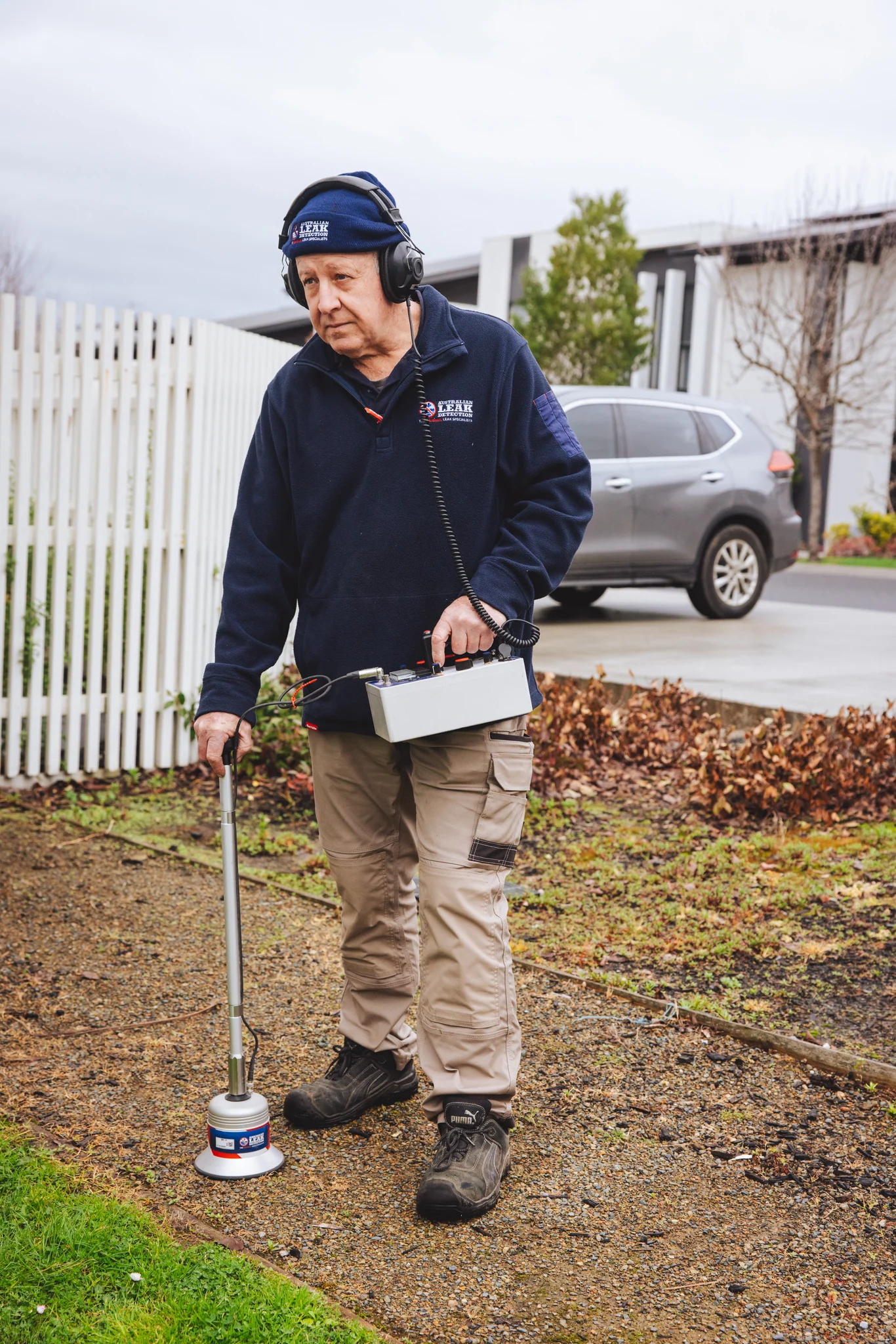
Our technicians carry geophones (ground microphones) and acoustic listening discs that amplify the sound by orders of magnitude. The technician places the disc on the surface, listens through professional headphones, and works methodically across the suspected area until the loudest signal indicates the source.
A pressurised pipe with a leak emits sound across a wide frequency range. Different surface materials transmit those frequencies differently. Concrete carries low frequencies. Soil dampens high ones. The technician adjusts the equipment to filter out background noise and focus on the leak signal — a process closer to tuning a radio than reading a meter.
Once the loudest point is identified, the technician records its position relative to the pipe path and any fixed reference points on the property. That single coordinate is what becomes the excavation target.
Acoustic detection is at its strongest on metallic pipes (copper, galvanised iron) under hard surfaces like driveways, slabs, paving, and tile. Hard surfaces conduct sound efficiently, and metallic pipes resonate cleanly.
It also works well on the mains supply line — the high pressure of an active leak in a main produces a clear, sustained signal that an experienced technician can locate within 1–2 metres.
Acoustic is almost always the first technique we deploy on any leak detection job. It is non-invasive, fast to set up, and gives an immediate read on whether a leak exists at all. Even when we end up using thermal imaging or tracer gas to confirm, the acoustic scan tells us where to focus.
On a typical residential property, an acoustic survey takes 30–90 minutes. The technician walks the property, listening at known reference points along the pipe path, narrowing in until they're confident in the location.
From the homeowner's perspective, acoustic detection is just a technician walking around with a stethoscope-style probe and headphones. There's no equipment trolley, no excavation, no trail of damage. Most clients can carry on with their day uninterrupted.
If you stand still and listen, you might catch the high-pitched signal yourself once the technician points it out — the sound of a leak in a metallic main is surprisingly clear once you know what to listen for.
Acoustic detection is the cheapest, fastest, least disruptive technique in our toolkit — and on most jobs, it gets us 80% of the way to the answer. The remaining 20% is what justifies the additional tools below.
It is also the technique that produces the strongest evidence for an insurer or water authority. A located leak with a documented acoustic reading is the standard piece of supporting evidence for a Leak Allowance claim.
You don't need to know whether it's in the wall, underground, or under your slab. Just tell us what you've noticed, and ALD will take it from there.