
Water & Pipe
Pool & External
Tracer gas detection is the practice of introducing an inert gas — typically a 95% nitrogen / 5% hydrogen blend, or pure helium — into a water line that has been emptied and isolated. The gas escapes at the breach, percolates up through the soil or building material, and is detected at the surface by a hand-held sensor.
Both gases are completely safe and undetectable to humans — they are non-toxic, non-flammable in the concentrations we use, and do not react with anything in the pipe or the surrounding soil.
The technician isolates the line at a shut-off valve or capped fitting, drains the water, and connects the tracer-gas regulator. Gas is introduced at low pressure — far below the rated working pressure of the pipe — and the system is left to equalise.
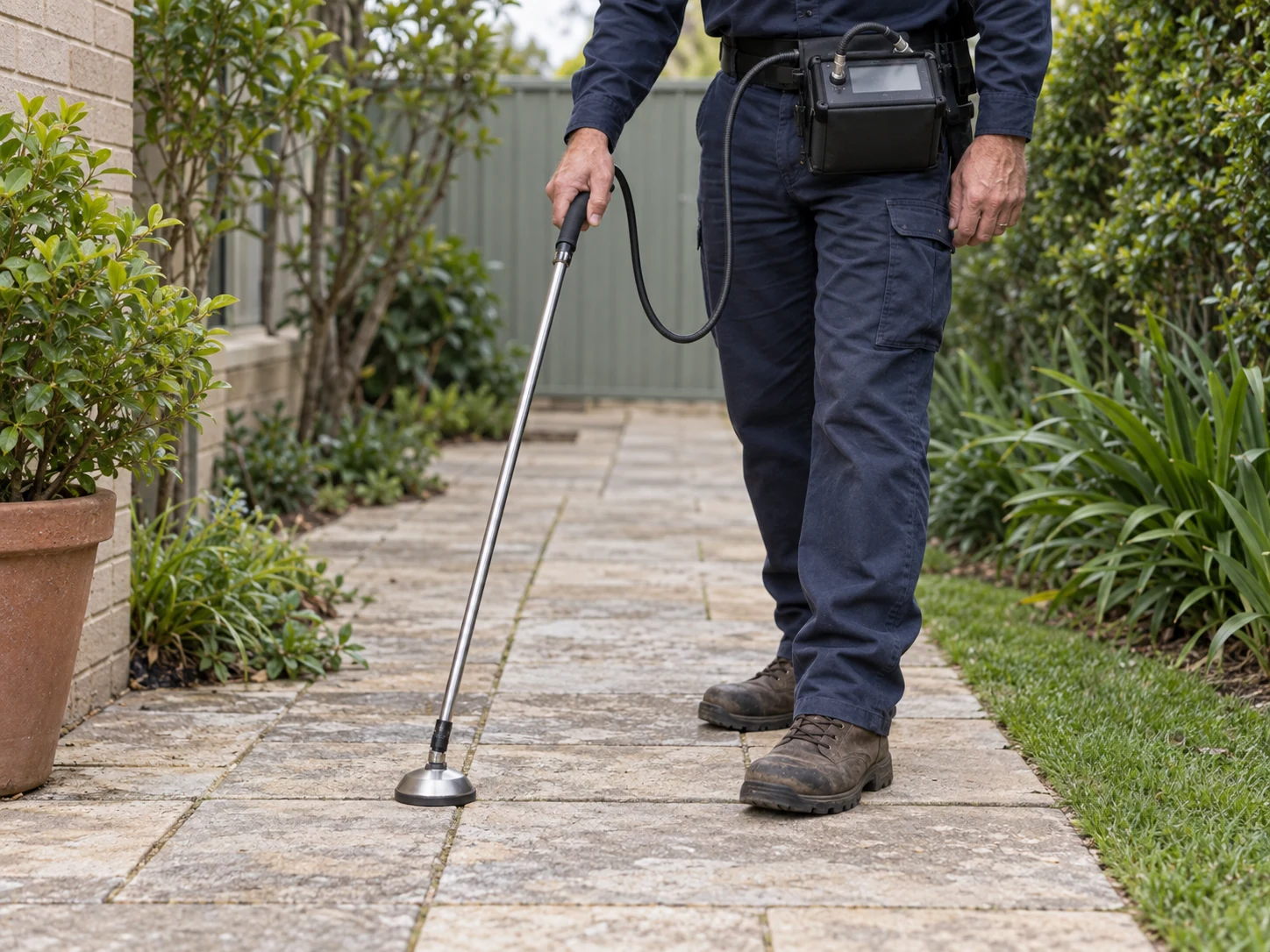
The technician then sweeps the surface above the suspected leak path with a calibrated detector. The detector responds to even trace quantities of the gas, so the location of the breach can be pinned to within a few centimetres.
Tracer gas is the technique of choice for old galvanised iron, polyethylene, and PVC supply lines — materials where acoustic detection is weak because the pipe wall absorbs the leak sound rather than transmitting it.
It is also the right tool when the property is unusually large, the pipe layout is complex, or the leak is so small that acoustic and thermal can't resolve it.
We deploy tracer gas as the second-line technique when acoustic detection has narrowed the area but not pinpointed the breach, or as the first technique on jobs where we know acoustic will struggle (long polyethylene runs, low-pressure laterals, large rural blocks).
A tracer-gas inspection adds 60–90 minutes to a typical job — most of that is the time to drain the line and let the gas equalise.
From your perspective, tracer-gas detection looks like a slightly more involved inspection — there's a regulator and a small gas cylinder on the equipment trolley, and the technician spends more time at the meter or shut-off than they would on a pure acoustic job.
The water supply is interrupted while the line is drained and tested — typically 30–60 minutes — so we coordinate timing if you need water during the visit. There is no smell, no residue, and no impact on the pipe itself.
Tracer gas is the technique that closes the case on the leaks no other tool can find. Plastic mains under driveways, old galvanised supply lines that have lost their acoustic signature, low-pressure systems where the leak signal is below the noise floor — all of these are tracer-gas jobs.
Without tracer gas in the toolkit, the only fallback for those jobs is exploratory excavation — exactly the destruction we are here to prevent.
You don't need to know whether it's in the wall, underground, or under your slab. Just tell us what you've noticed, and ALD will take it from there.