
Thermal Imaging & Infrared Detection

What It Is

Thermal imaging is the practice of looking at the world through an infrared camera. Where moisture is present — even hidden moisture behind plaster, under tiles, or above a ceiling — it changes the surface temperature of the building material around it. The camera shows us the shape and extent of that change as a colour map.

A modern thermal camera resolves temperature differences as small as 0.05°C across an entire frame. That sensitivity is what lets us see a wet patch behind a painted wall as clearly as a hand on a glass window.

How It Works

Hot water moving through a leak appears warm — orange or red on the camera display. Cold water leaking from a cold-water main appears cool — blue or purple. Either way, the leak is visible against the background temperature of the surrounding material.

The technician scans surfaces methodically and watches the live thermal feed for the tell-tale plume shape that distinguishes a leak from, say, a heating-element artefact or a sun-warmed patch.

What It Detects Best

Thermal imaging is at its strongest on hot-water lines, in-slab heating, and any plumbing in a temperature-controlled space. The temperature differential between the leak and the surrounding surface is the signal — the bigger the differential, the easier the find.

It also performs well on concrete floors, tiled wet areas, and underground lines where there is enough thermal contrast between the soil and the leaking water to register on the camera.

When We Use It

Thermal imaging is a standard part of every wet-area inspection — bathrooms, balconies, kitchens, and any room where water has shown up unexpectedly. It is also the primary technique on large properties where a single acoustic sweep would take all day.

Often we run a thermal scan as the second pass after acoustic — to confirm the leak location visually, document the wet area, and capture imagery for the report.

What The Client Experiences

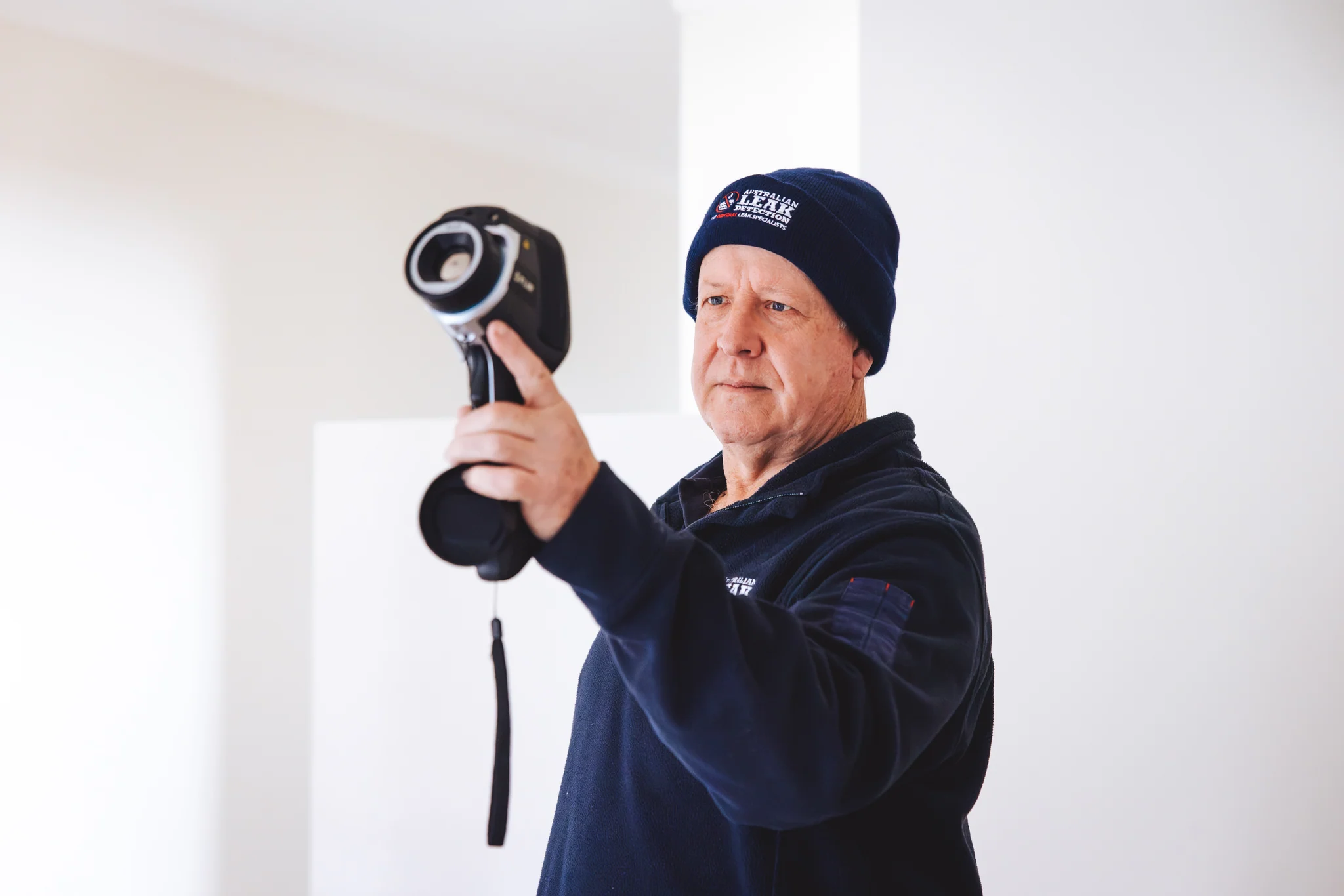
A thermal inspection looks unremarkable from the outside — the technician walks the area with what looks like an ordinary camera. The display shows the colour-mapped temperature in real time, and they often turn it around to show you exactly what they are seeing.

Nothing physical happens to the property. No probes are inserted, no surfaces are touched. The whole inspection is captured digitally and included in the report.

Why It Matters

A thermal image is a literal photograph of the leak — a physical record of the wet area exactly as it existed at the moment of inspection. Insurers, strata committees, and water authorities accept thermal imagery as objective evidence in a way they often won't accept a written description alone.

Used together with acoustic detection, thermal imaging removes ambiguity. The acoustic reading tells us where the leak is loudest; the thermal image confirms where the moisture has spread to. Two independent measurements converging on the same spot give a confidence level no single technique can match.

Not sure what type of leak you have? That's exactly why we exist.

You don't need to know whether it's in the wall, underground, or under your slab. Just tell us what you've noticed, and ALD will take it from there.